
Projects available
Applications are invited for the AI for Drug Discovery Programme for the available projects listed below.
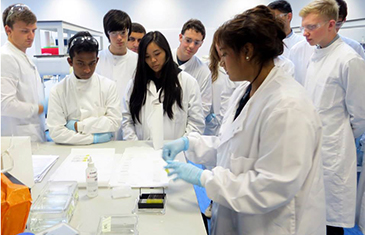
We are delighted in this cross-faculty and cross-disciplinary training programme with our industrial partners to train the next generation of drug discovery researchers— Professor Michael Barnes, Professor of Bioinformatics. The William Harvey Research Institute, Faculty of Medicine and Dentistry
Please see below details of the available projects for the 2025-26 intake. Please note the application deadline as listed per project and ensure your application is submitted in-time. Available projects are open to candidates who meet the UKRI terms and conditions, and are classed as Home for tuition fee purposes. Further details in the project descriptions below.
Each project has a supervisor based at Queen Mary, and engagement from Industry, including the option for a placement. The level of industry engagement varies depending on the nature of the project. We suggest you review each project description to learn more about the proposed research. Once you have identified your top project, you can submit an application via the Apply page. Note, you will be asked to identify your chosen project, and a maximum of 1 other project; you cannot apply for more than 2 projects, so we recommend you consider your choice carefully, ensuring that it is the right fit for you and your research aspirations.
Points to consider when reviewing projects:
- Is the project a good fit for my research experience to-date, and my research interests?
- Do I have the necessary background knowledge, or could I reasonably acquire this through targeted training on the programme?
- What attracts me to this project, and which part of the project most excites me?
- Does the supervisory team seem a good fit for me, and what makes me want to work with them?
Development of AI framework for iPSC image analysis and integration
Start date: by April 2026
Deadline: 8th February 2026
Background
The Draviam lab aims to understand the molecular principles that govern cell division and the consequence of its failure when cells transition between states during differentiation. Together with MSD, the project aims to focus on developing AI methods to track iPSC (induced Pluripotent Stem Cells) differentiation to neural precursors, astrocytes and neurons. During the process of differentiation, quiescence and senescence are two cell dormancy states with distinct cell fates and transcriptomic statuses. However, these two states of dormancy have similar nuclear shape and size presentation (in images) which we aim to separate by developing a DL-based image analysis framework that tracks their behaviour through time. The ideal candidate is expected to have a strong background in image analysis, development of ML/DL methods, a keen interest in biosciences and provable experience in teamwork.
Eligibility and Applying
We are looking for highly motivated individuals who are passionate about contributing to new discoveries in drug discovery bioscience through the application of the latest techniques in AI and data science.
We are looking for highly motivated individuals who are passionate about contributing to new discoveries in drug discovery bioscience through the application of the latest techniques in AI and data science. Ideal candidates will have a grounding in both a natural science and data science, e.g. through a Master's degree or work experience in a subject such as bioinformatics or computational chemistry. Alternatively, you may have, for example, a first-class degree in computer science followed by biochemistry experience, or vice versa (qualifications and evidence thereof must be obtained before April 2026). You will be confident in performing data wrangling and analysis in a language such as Python, R or C++. Effective communication skills are essential.
We particularly encourage students from groups that are currently underrepresented in postgraduate science research, including black and minority ethnic students and those from a socio-economically disadvantaged background.
Applicants must be available to start their PhD by April 2026.
The Studentship will cover tuition fees, UKRI stipend (currently £22,780) and a consumables allowance for a period of 4-years (pro-rata for part-time).
Supervisors:
Viji Draviam - Professor of Quantitative Cell and Molecular Biology and Director of Industrial Innovation, School of Biological and Behavioural Sciences, QMUL
Wei Wei - Associate Principal Scientist, MSD
Project Partner:
MSD